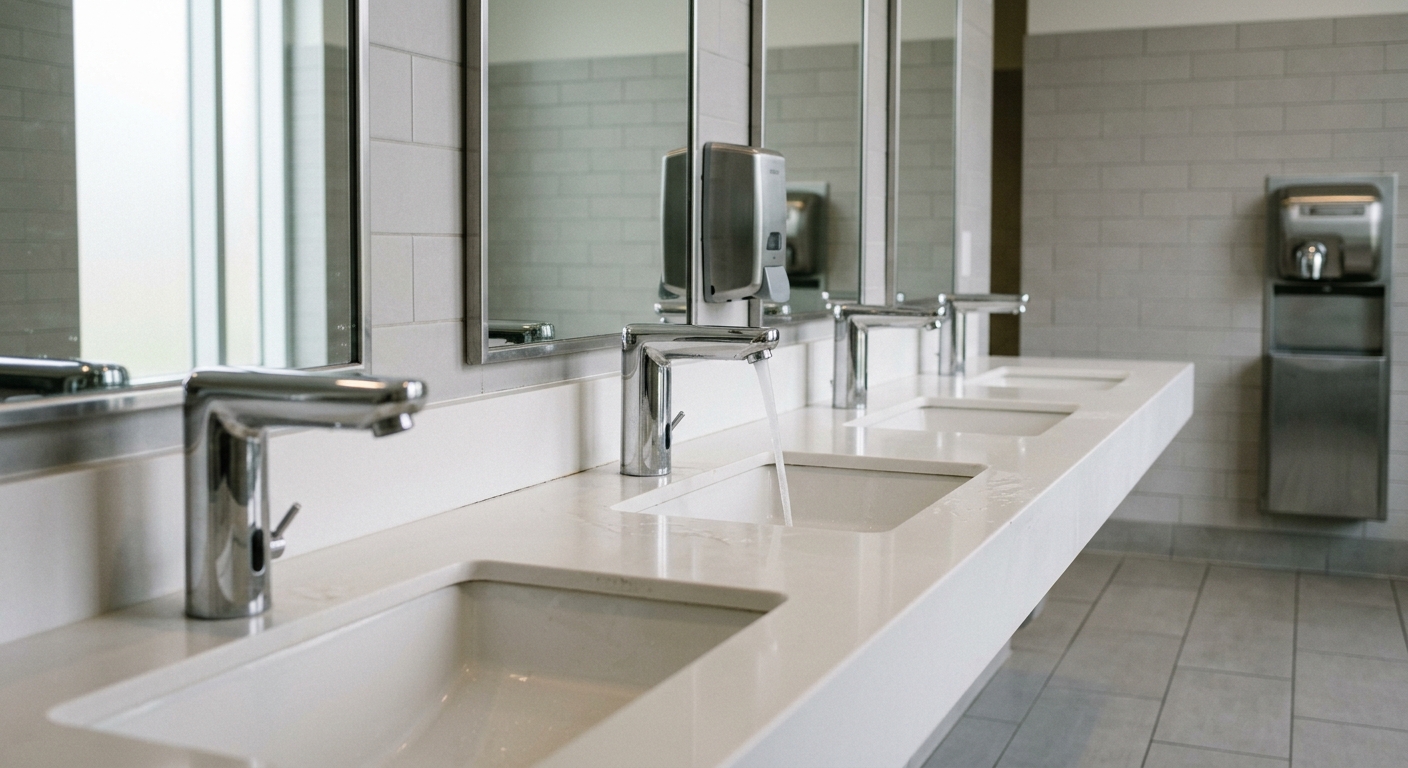
Yes, but the difference is not the faucet’s feature list. It is duty cycle. A clinic restroom used by 150 patients a day and a two-person office restroom used by the same staff every day put entirely different load profiles on the same sensor faucet, and specifying by price point instead of activation count is how you end up replacing batteries weekly or swapping solenoids every year.
Estimating Daily Activations by Space Type
Before comparing specs, estimate activations per fixture per day. This number drives every other decision in this article.
- Small office (under 20 staff): 20-60 activations per day per faucet, concentrated in morning and lunch windows.
- Cafe or coffee shop: 80-200 activations per day, driven by customer turnover and staff handwashing between food handling tasks.
- Clinic or urgent care: 150-400+ activations per day per faucet, with heavy use in patient-facing and staff scrub sinks alike.
These are planning ranges, not measured averages, because actual counts depend on staffing, hours, and whether the sink is patient-accessible or staff-only. If you have an existing space, a rough headcount times visits-per-person-per-day gets you close enough to size the system.
Battery vs AC Power at Scale
Battery-powered sensor faucets run on 4-6 AA or lithium cells and are the standard choice for low-cycle applications. At office-level activation counts, expect battery life in the range of 12-24 months depending on cell type and how long the solenoid stays open per cycle. At clinic-level counts, that same battery pack can drop to 3-6 months, and a missed replacement means a dead faucet in a space where handwashing compliance matters.
AC-powered units (typically a 6V or 12V transformer wired to a junction box) eliminate the replacement cycle entirely and are the correct default for any restroom projecting over 100 activations per day per fixture. The tradeoff is upfront electrical work: a low-voltage circuit, a transformer location, and coordination with an electrician if the restroom wasn’t wired for it. For clinics and cafes, that one-time labor cost is cheaper over a three-year horizon than recurring battery service calls, especially across multiple fixtures.
Some commercial units support both battery and AC input, which is worth specifying if you’re not certain about future traffic. It lets you launch on batteries and hardwire later without replacing the faucet body.
Sensor Range and False-Trigger Risks
Sensor faucets use infrared detection set to either near-field or far-field range, and the wrong range for the space causes two different failure modes: missed activations or phantom triggering.
- Near-field (2-4 inches): Requires hands close to the spout. Lower false-trigger rate in tight, high-traffic layouts where users or splashback could otherwise set off the faucet. Best for compact clinic sinks and multi-fixture counters where adjacent activity is common.
- Far-field (4-6 inches, some units to 8): More forgiving for users who don’t position hands precisely, but more prone to false triggers from reflective surfaces, nearby movement, or splashing water in tight quarters.
Cafe restrooms with single-user stalls can generally run far-field without issue. Clinic restrooms with adjacent sinks, wheelchair users needing more approach room, or stainless counters with high reflectivity should default to near-field or a range-adjustable sensor so you can tune it on site rather than guessing at spec time.
Solenoid Valve Duty Cycles Explained
The solenoid valve is the component that fails first under heavy use, and manufacturers rate it in cycles, not years. A valve rated for light-duty residential-adjacent use may be spec’d around 500,000 cycles; commercial-grade valves built for continuous service are typically rated well into the millions of cycles. Do the math against your activation estimate: a clinic faucet at 300 activations a day is roughly 110,000 cycles a year, which puts a light-duty valve into failure territory inside five years and a commercial-duty valve well within its service life over the same period.
When comparing commercial sensor faucets, ask for the solenoid’s rated cycle count directly rather than relying on a general “commercial grade” label, since that term isn’t standardized and duty ratings vary meaningfully between models built for light commercial use and those built for continuous high-traffic service.
Flow Rate and ADA Considerations
Commercial sensor faucets typically ship in the 0.5 to 1.5 GPM range, lower than the federal 2.5 GPM cap that governs residential fixtures, because commercial specs prioritize water and utility cost control over fill speed. For handwashing-only lavatories, 0.5 GPM is common and code-compliant in most jurisdictions; higher-traffic settings sometimes spec closer to 1.0-1.5 GPM to reduce perceived wait time at the sink without materially increasing water use per activation, since sensor faucets cut off automatically rather than running continuously.
ADA and ANSI A117.1 requirements govern more than flow rate. Operable parts, including any manual override or temperature control, need to fall within a 15 to 48 inch reach range, and the faucet control (sensor zone included) needs to be operable with one hand and without tight grasping or twisting. For sensor faucets this is generally straightforward since there’s no handle to reach, but if the unit includes a separate manual temperature knob or push-button override, confirm its mounting height meets the same range before final walkthrough.
Matching Specs to Clinic, Cafe, or Office
The table below is a starting specification, not a substitute for your actual activation count.
| Space Type | Est. Daily Activations | Power | Sensor Range | Solenoid Duty |
|---|---|---|---|---|
| Small Office | 20-60 | Battery (AC optional) | Far-field, 4-6 in | Light commercial |
| Cafe | 80-200 | AC preferred | Far-field or adjustable | Mid to high commercial |
| Clinic | 150-400+ | AC required | Near-field, 2-4 in | High commercial, millions of cycles |
Treat these as floor specs. If you’re outfitting multiple restrooms in one building with different traffic levels, it’s reasonable to spec differently per room rather than standardizing on one faucet for the whole project.
Before You Order
Pull your actual visitor or patient counts for a representative week and divide by restroom fixture count to get a real daily activation number per faucet, not an estimate from a table. Confirm with your electrician early whether AC wiring is feasible at each sink location, since retrofitting low-voltage runs after tile and counters are in is more expensive than planning for it during rough-in. If a distributor can’t give you a solenoid cycle rating or a sensor range spec in writing, treat that as a sign to ask for a different unit, not just a different vendor.